
Creative Effectiveness: It's Not Rocket Science
We talk a lot about creative effectiveness in advertising. And actually, I think it is simpler than people make it out to be.
To quote a client: “The founders just want to see a spike”.
The idea of success rarely budges very far from this objective. Business leasders want to see the bottom line increase when they spend money on advertising. So how can you build in guarantee that this will happen?
There is a tonne of information on how to design a strategy for effectiveness, how to build a brand. And the most stark and encouraging fact for SMEs is that:
Creative is the biggest driver of return on investment.
You can’t deny it. I know would say that. I own a creative agency, and I see the impact of the creative in campaigns planning every day. But it comes across loud and clear when you look at the research. They say focus on what you can control and don't worry about what you can't. And whilst it's very hard to control audience trends, viewing habits and market movement, we absolutely can control the creative content we put out into the world, and the decisions we make in that creation process for our brands.
Now in this article I am talking about video content and specifically ads, but these principles apply to any content that you make for your brand.
Brand is a by-product of activity. Sales are a direct result of the composition of content.
And as I always say — it's only sexy if it sells. You can start with a big shiny idea, but if it doesn't turn eyeballs into income it loses its shine very quickly and finds itself in the discard pile.
So how exactly can you build in guarantees that viewers will act, and that when you launch your campaign into the world it will deliver results?
I have spent 18 years learning and implementing how to convert viewers into customers, and the past 10 years refining the systems that enable us to build guarantees and de-risk the advertising we deliver. What follows is the clearest distillation of that I can give you.
The Real Problem With Most Content
The problem with most people's content is that there is no framework to hang ideas off. So each piece of content or ad is pot luck — hit and miss as to whether this one lands. One week you might have high reach and real success, the next week you dip, and it leaves you guessing.
The other problem is that it has become so easy to make content that people make it and throw it out to test it. Which in itself is not a problem — the only real test of creative is with live media. But as Jason Trout puts it on the podcast Marketing in the Madness:
"The creative bar has got lower because you've got unlimited supply. And whenever you've got unlimited supply, the natural inclination is to just lob stuff out there and see what sticks."
There are two things you need to understand to make attention grabbing and successful content. First, copywriting formats — the established frameworks for how to structure messaging. Second, what specific elements you need to put into a script in order to get out the result you want.
Start With the End in Mind
Know what you want to achieve. Are you looking to extend your brand awareness? Do you want to broaden the audience you're speaking to? Do you want to push a particular product or offer? Is it a seasonal objective or a sale campaign? Or is the objective simply to see a spike in sales?
When we know what we are aiming for at the start, we can be a lot clearer about what to say — and crucially, what not to say. There are hundreds of micro decisions that go into creating quality video for advertising, and each one should be informed by the brief that you come back to time and time again.
When you know what you want the audience to do, you know what the call to action should be. When you know who you want to reach, you know the type of personality to put in the ad. When you know what you want the audience to feel, you can build the tone and mood of the piece.
The Shit In, Shit Out Rule
What you put into a script or idea directly affects the output you get out the other end. If you are guessing and don't have a plan, you won't be getting results from your content. But when you have a clear plan on how to structure content to nurture your audience towards a sale within a piece of content, you can dial this up and guarantee the outcome. It stops you guessing on whether it will work or not. So think what you want to achieve from the piece of content, and weave it into the copy. At the end of the day — the objective is very rarely anything but sales.
Frameworks: The Structures That Actually Work
There are some very well established frameworks for how to structure messaging and they are good to this day because they work with how our brains naturally unpack stories in a logical order.
Problem — Agitate — Solution is perhaps the simplest and most enduring. You show the problem, or someone experiencing the problem. You ask a question — do they recognise their life like this? Would they like a life that looks like x, y, z instead? The objective is to highlight the problem your audience is currently suffering, and make clear that you are going to solve it.
The 4 Ps — Promise, Picture, Proof, Push is another long-standing framework that structures content around making a bold promise, painting a picture of what life looks like with that promise fulfilled, backing it up with proof, and pushing the audience toward action.
These aren't new. But that is precisely the point. They are well established because they work.
Money Doesn't Buy Products — Emotions Do
Any marketer knows that we buy because we are drawn to buy through emotion. The feelings we have towards a product, the trust that is built with a brand over time.
During the 1970s, psychologist Paul Ekman identified six basic emotions he suggested were universally experienced across all human cultures:
Happiness
Sadness
Disgust
Fear
Surprise
Anger
He found that these emotions affect our choices, actions and perceptions. This matters enormously when we think about what to put into a script or piece of content.
The main point is this: when you know what emotion you want people to have towards the product or the problem, you can recreate that for them in the scripting.That is where the real connection comes from.
The Missing Pieces That Separate Good From Great
The Brief: It doesn't have to be complex, but it must be clear. In its most basic form, a good brief identifies who you are talking to, what you want to say, what you want the audience to do, and the outcome you want. That's it. But ignoring or deviating from the brief is where campaigns can quietly fall apart as they progress.
The Script: This may feel like a waste of time if you are a small team, or even a team of one. You know your intentions, so why slow down to write it out? But this is where you see the idea in action before the idea is in action. It doesn't have to be a full script depending on the format — it could be a storyboard where you can see the flow and spot the gaps. Either way, when you plot things out first, you get to see where the flow is, what the tone and mood and story really are, and crucially where the holes are before they become expensive.
The Response House: 8 Components of Ads That Actually Drive Effectiveness
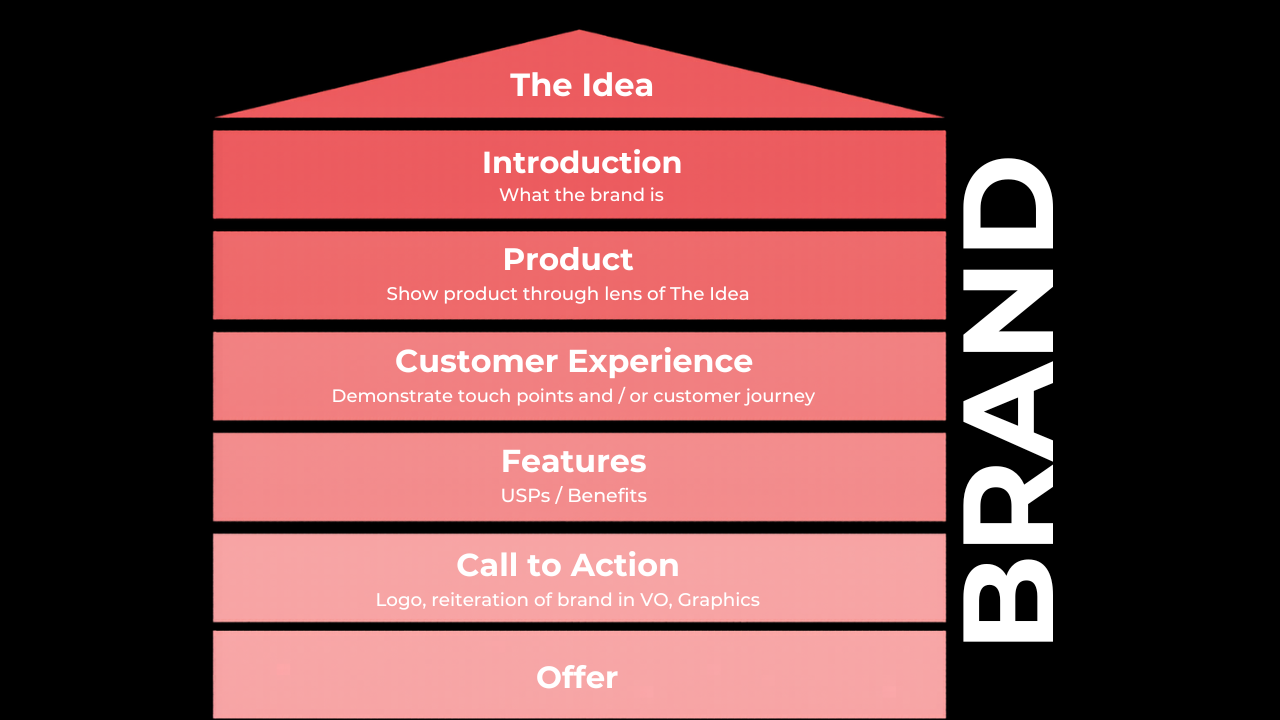
After years of studying advertising copywriting and direct response effectiveness, we identified 8 core components that can optimise the response of any video creative. You can dial them up or down depending on how ‘direct response’ you want to be, but the more effective your ad will be. Ask yourself honestly — am I including these?
The Idea: Creative is king. Does your idea evoke the right emotion? Does the story, tone and mood embody your message? Does it make people know, like or trust you?
Introduction: Is your brand featured visually in the first 5 seconds? If you are a lesser-known brand, this is your highest-engagement moment — use it.
Product:Show the product through the lens of the idea — in situ in the story. Show how it solves a customer problem. Include visual cues: logos, colours, taglines. Subtlety isn't cooler.
Customer Touchpoints: Demonstrate how the customer interacts with your product. Show realistic scenarios with relatable characters. Where else will they meet you in their customer journey?
Features: Be clear on your USPs and benefits — but don't stuff the ad with them. Typically 6 to 7 phrases can be included comfortably in 30 seconds before you start overwhelming the viewer. Make benefits tangible and relatable.
Call to Action. Is your brand logo or CTA running throughout, or only at the end? The more it is seen, the more responsive the ad. QR codes can make good use of the second screen in certain environments.
Offer. Does your ad give a persuasive reason to act now? Strong offers drive immediate response, while the presence on screen supports longer-term brand goals.
Brand Wrapping. Is the ad visually consistent with your brand across all touchpoints? Would someone see it and know immediately it is you? Do you have a brand device - a mascot, sonic or visual device, tagline. What abot the ad says “this is us” clearly and is compatible with other channels?
The TLDR
Creative effectiveness isn't about having the biggest budget or the flashiest idea. It is about knowing what you want, building it with intention, and giving your audience the right emotional reason to act.
Our Response House gives you the exact framework we use to make campaigns intentionally more effective. Follow this and watch your results soar. We’ve proved it. Get in touch to learn more at team@studio90media.co.uk
Brand is a by-product of activity. Sales are a direct result of the composition of content. Get the composition right, and the results follow.
The frameworks exist. The structure is there. The only question is whether you are using them.
Want the frameworks, tools and resources to help you push above your weight in advertising? Join the TV Curious Club for free— a space built for founders, marketers and brand guardians who want to make creative that actually works. You'll get access to the exact frameworks we use to de-risk advertising and build campaigns that deliver.